A 5-Point Guide to Choosing the Right Location for Your Chiropractic or Holistic Healthcare Practice
Choosing the right office location is one of the most important business decisions you’ll make. Whether you’re opening your first chiropractic office, expanding a functional medicine practice, relocating a wellness clinic, or adding a second location, the site you choose will influence patient growth, visibility, staffing, profitability, and your long-term success.
Before signing a lease, it’s important to evaluate more than just the building itself. The surrounding community, patient demographics, future growth, accessibility, competition, and your long-term business goals all play a role in determining whether a location will help your practice thrive.
At CrossFields, we’ve found that the most successful healthcare offices begin long before design or construction. They begin with choosing the right location. By taking a strategic approach before committing to a space, you can avoid costly real estate mistakes and create a stronger foundation for your practice.
In general, start your location search at a high level by identifying the city or area where you want to practice. Then progressively narrow your search until you identify the communities that best fit your vision.
The 5 points below will help you evaluate potential locations with both your patients and your long-term business goals in mind.
Interested in the Next Steps? Download our 5-Phase Checklist. This resource lays out individual tasks with specific dates to keep you on track for the opening of your office!
1. Does the Location Match Your Ideal Patient?
To begin, determine the area’s compatibility with your practice’s goal clients. This will help you find out if your ideal clients are in the area you are looking at. More ideal clients will mean more business!
First, educate yourself on the demographic of the area that you are targeting.
- What is the average age of the people in the area
- What is their median income?
- Are families moving into the area?
- Is the population expected to grow?
- What types of businesses and employers are nearby?
Do these demographics line up with the target audience for your practice?
You can find all of this information through a simple web or AI search. Each category will show differently on a map or chart, so pick one or two that are most important to you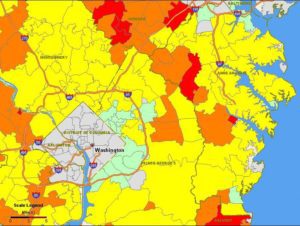 .
.
This example map of Washington, DC area shows the concentration of individuals per age. The dark red areas indicate where the highest concentration of people over 55 are living, while the yellow areas show the lower concentration of people over 55.
Now, the information you find can help you choose a location based on your target marketing. For this example, if your practice is geared toward an older demographic, you’ll want to look in the dark red areas. But if you have a pediatric-based or pregnancy-based practice, you’ll focus on the yellow areas.
2. Is the Area Growing?
Current demographics tell you where a community is today. Growth trends help predict where it will be tomorrow.
If the area is growing, it’s a good sign that they will need a new business, like yours! One way we like to determine if an area is growing is by searching for something called housing permits to see where new homes are being built. Search online for a map based on housing permits issued for the last 6 months to see where the highest percentage of residential homes are being built in your community.
Another way to determine growth is if there are public development projects in the works. Good questions to Ask:
- Are roads being widened?
- Are new shopping centers planned?
- Is a new interstate interchange being constructed?
- Are new schools being built?
- Are there economic incentives encouraging residential or commercial development?
Besides an online search, your local Chamber of Commerce, economic development office, or city planning department can often provide valuable insight into future growth plans.
Choosing a location based on where a community is headed—not simply where it is today—can position your practice for long-term success.

3. How does your practice differ from the competition?
Another way to narrow down your options is to search for similar businesses in your target community. Are there already holistic healthcare providers offering the same type of practice as yours? How will your practice be different? What do you add to the community that isn’t already covered by an existing doctor in the area?
A few ways to start this research include mapping out all offices in the area and other wellness-type centers.
- Functional medicine practices
- Wellness centers
- Integrated healthcare clinics
- Physical therapy offices
- Medical spas
- Massage therapy providers
Mapping these businesses gives you a clearer understanding of the local healthcare landscape and may reveal opportunities where your services fill an unmet need.
One resource we’ve found helpful is Locus Chiropractic Demographics, which provides demographic information, market analysis, and healthcare mapping tools. Locus Chiropractic Demographics.
Locus also has many other resources for finding out the above information on its website.
4. Think Beyond the Building
It’s easy to fall in love with a particular office suite.
The finishes look beautiful.
The lobby feels impressive.
The rent seems reasonable.
But before making a commitment, ask a few additional questions.
- Is the location easy for patients to find?
- Is there adequate parking?
- Is the building highly visible from the road?
- Can the space support your patient flow?
- Will it accommodate future growth?
- Does the lease support your long-term business goals?
Remember, you’re not just choosing office space. You’re choosing where your practice will grow.
5. Don’t Let Emotion Make the Decision
After gathering your research, you may still find yourself struggling with the decision.
That’s normal.
Healthcare providers often develop an emotional attachment to a particular building or neighborhood. While intuition has value, major real estate decisions should ultimately be supported by objective information.
We’ve seen many situations where the “perfect” building turned out to be the wrong long-term investment—and others where an overlooked location became the ideal solution.
Making this decision before signing a lease can save significant time, money, and frustration later.